

The Wandspringer was published in August 2025 by Foolscap and Quill, who are a fantastic press based in Colorado.
The Wandspringer is a middle-grade time travel/espionage story.
‘When Ellie uncovers a hidden link between her missing father and a legendary spy, she’s drawn into a daring mission across time. With history in the balance and danger around every corner, Ellie has to face her fears and find the courage to save the future.’
The concept for The Wandspringer developed from some inter-connected events.
When we were planning a family trip to Berlin my daughter started to draw a comic book, Lily Fly, Super-Spy.
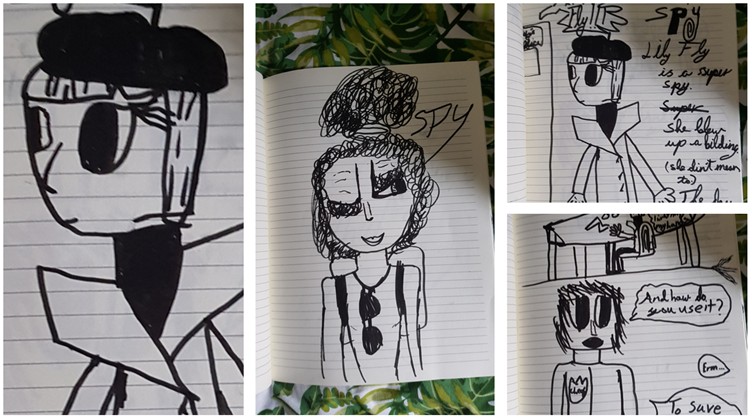
The beret and trench coat which conceal the identity of the Wandspringer come from this initial drawing.
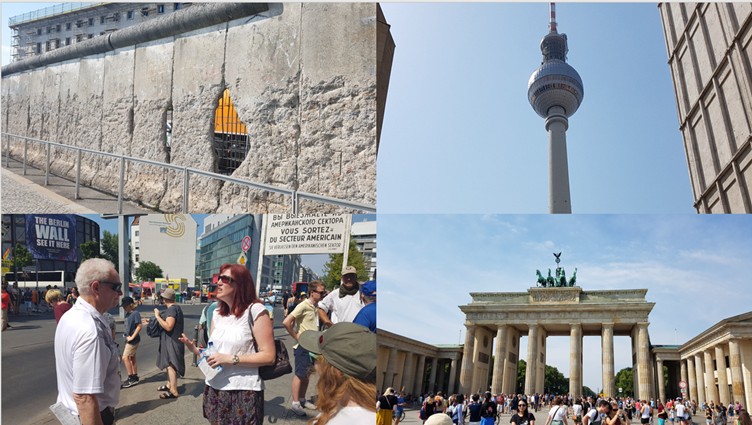
On the trip to Berlin we saw the Brandenberg Gate, memorials to the Berlin Wall, alongside other locations that feature in the novel. We also met some veterans who were station at Checkpoint Charlie in the 1960s.
It was taking refuge under the TV tower on an unusually hot day that I started to tell the story of Lily Fly in Berlin.
The development of the first draft was very quick as the aim was to write the full draft of the story for a birthday present.
The main story arc had already been worked out and the next step involved setting out the main plot points as chapter headings.
This was done by hand, with sections and scenes also being handwritten when the time allowed.
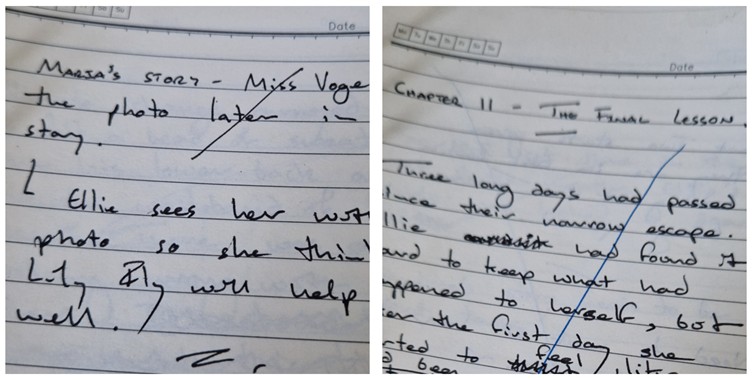
Once these scenes were outlined the manuscript was written on a computer, again when time allowed – evenings, weekends and even on long car journeys.
The draft was then printed, hand cut, an image of the photograph that is central to the story was created and then the book was hand bound, wrapped and given as a birthday present.
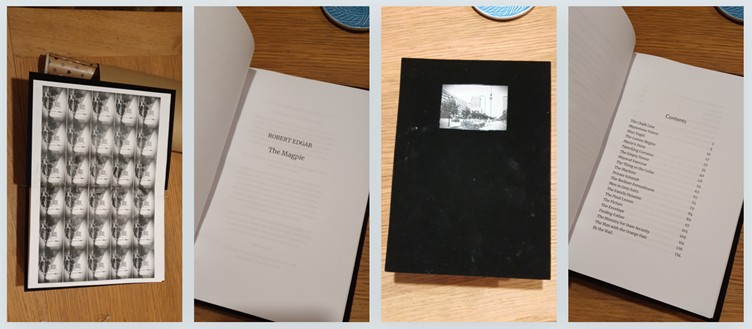
The speed of production left more than a few typographical errors in this initial book.
On revision the structure of the book needed a little amendment for a wider readership.
The first chapter was the story of a solider who is involved in the drawing of a line on the ground, which marked where the wall would be built.
This historical detail became the opening that you can now read in The Wandspringer. We now start with Ellie in Berlin awaiting the help of the mysterious spy.
There are many sources which were used in the development of the book especially in trying to evoke what it was like to live in East Berlin, both for those who believed in the regime as well as those who didn’t. In particular Anna Funder’s Stasiland was an invaluable recourse and Peter Schneider’s The Wall-Jumper an inspiration.
The manuscript was reviewed by and additional feedback incorporated before the synopsis was written and sent to Darlene at Foolscap and Quill.
Darlene’s edits were very helpful in shaping the version that you can read. The process I followed to was to edit on two paper copies before reading the final proofs.
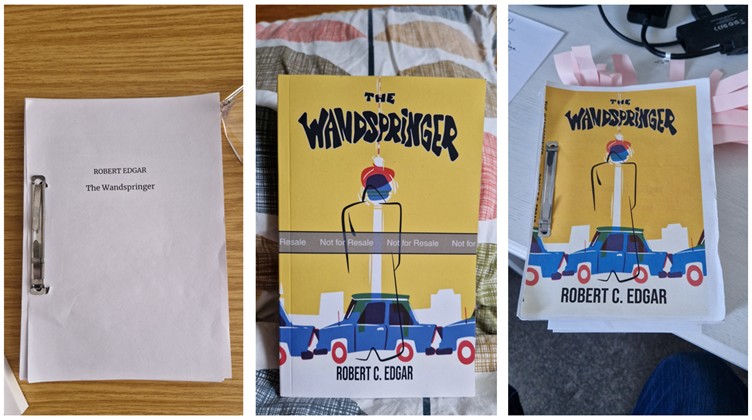
The cover design was undertaken by Max Bicknell who drew initial sketches following the synopsis and the description of the photograph that is at the centre of the story before he designed the cover which represents that image but also captures the feel of 1970s design.

The Wandspringer – Press Release
 Robert Edgar